Tranq: The Xylazine Epidemic — What It Is, What It Does, and Why It Is So Hard to Treat
There is a drug in the illicit supply right now that most people have never heard of — and it is killing thousands of Americans every year. It is not an opioid. Narcan will not reverse it. It causes wounds so severe that some people lose limbs. And it is in the drug supply in all 50 states.
Its name is xylazine. On the street, it is called tranq — or, when mixed with fentanyl, tranq dope. If you are working in or preparing to work in substance use disorder (SUD) treatment, this is one of the most important emerging threats you need to understand. This article covers everything: the history, the pharmacology, the wounds, the withdrawal, the treatment challenges, and what it means for your work as a counselor.
What Is Xylazine?
Xylazine is a central nervous system (CNS) depressant that was developed in the 1960s as a veterinary sedative, pain reliever, and muscle relaxant. It is FDA-approved for use in animals — horses, cattle, dogs — but has never been approved for human use. It is not a controlled substance under the federal Controlled Substances Act, which has complicated efforts to regulate it.
Xylazine works by activating alpha-2 adrenergic receptors in the brain and nervous system, producing deep sedation, slowed breathing, reduced heart rate, and lowered blood pressure. In veterinary settings, these effects are carefully dosed and monitored. In humans using illicit drugs, the effects are unpredictable and frequently life-threatening — especially when combined with opioids like fentanyl, which is almost always the case.
It can be injected, snorted, swallowed, or inhaled. In the vast majority of cases, people using tranq do not know it is in their supply. It is an adulterant — added to fentanyl by drug dealers to extend the high, increase the weight of the product, or enhance the sedative effect. The person buying the drug often has no idea what they are actually taking.
The History: From Puerto Rico to All 50 States
Xylazine did not appear overnight. Its entry into the human drug supply followed a slow, then rapid, trajectory that mirrors the broader opioid epidemic in troubling ways.
1960s: Xylazine is developed as a veterinary sedative and analgesic. It is used widely in large and small animal medicine worldwide.
Early 2000s: Xylazine first appears in Puerto Rico’s illicit drug supply, mixed with heroin. Medical examiners begin documenting xylazine-related deaths. At this point, it is largely a regional phenomenon.
2010s: Xylazine begins appearing in Philadelphia’s drug supply, where it becomes known as “tranq dope.” Philadelphia becomes the epicenter of the tranq crisis in the continental United States. The combination of xylazine and fentanyl produces an unusually prolonged, deep sedation that users seek out — and the distinctive skin wounds begin appearing in emergency rooms and harm reduction programs.
2019–2022: Xylazine spreads rapidly across the United States. Detection in drug seizures more than doubles across 30 states. The CDC reports that in 20 states plus Washington D.C., the percentage of fentanyl-related overdose deaths that also involved xylazine increased by 276% — from 2.9% in January 2019 to 10.9% in June 2022.
2023: The White House Office of National Drug Control Policy declares the xylazine/fentanyl combination an “emerging threat to the United States.” The CDC reports that xylazine has become the 4th most common drug involved in overdose deaths, with 6,096 deaths reported that year. All 50 states now have confirmed xylazine in their drug supply.
2024–2026: Xylazine is now a nationwide crisis. A new adulterant, medetomidine (a related alpha-2 agonist used in veterinary medicine), is also beginning to appear in the drug supply in some cities, suggesting that the pattern of veterinary sedatives entering the illicit market is not limited to xylazine alone.
What Xylazine Does to the Body
Understanding xylazine’s effects on the human body is essential for anyone working in SUD treatment. The drug produces a constellation of effects that are dangerous on their own and catastrophic when combined with opioids.
Central Nervous System Effects
Xylazine is a powerful CNS depressant. It slows brain activity, reduces heart rate, lowers blood pressure, and depresses the respiratory system. When combined with fentanyl — which also suppresses breathing — the combined effect can reduce respiratory function to the point of death. People who overdose on tranq dope often enter a state of deep unconsciousness that can last far longer than a typical opioid overdose, making them harder to rouse and more vulnerable to secondary harms like aspiration, hypothermia, and positional asphyxia.
The Wounds: The Most Visible and Devastating Effect
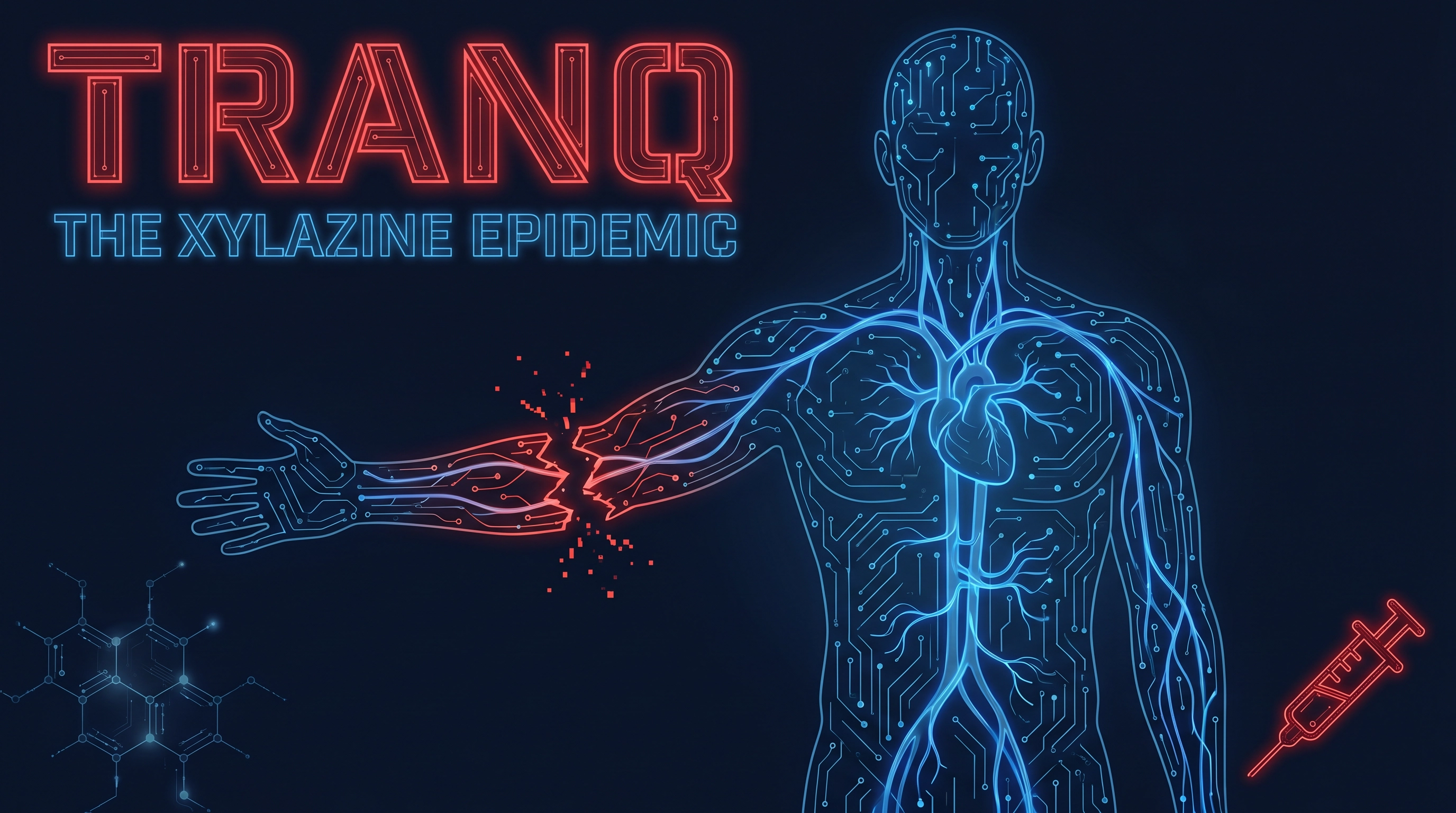
The defining and most alarming feature of xylazine use is the skin and soft tissue wounds it causes. These are not ordinary injection site abscesses. They are severe, painful, slow-healing sores that can grow into large patches of dead and dying tissue — a process called necrosis.
What makes these wounds particularly alarming is that they do not only appear at injection sites. They can develop anywhere on the body — including in people who smoke or snort xylazine rather than inject it. The exact mechanism is not fully understood, but researchers believe xylazine causes blood vessel constriction that reduces circulation to the skin, leading to tissue death even at sites remote from the point of drug entry.
In severe cases, these wounds can become so extensive that they require surgical debridement, skin grafting, or in the most extreme situations, amputation. Emergency rooms and wound care clinics in cities with high tranq prevalence have reported patients with wounds covering large portions of their arms, legs, and torso.
For SUD counselors, this means that a client presenting with unusual, non-healing skin sores — especially in multiple locations — may be using xylazine even if they do not report it or do not know it is in their supply.
Why Narcan Does Not Work on Tranq
This is one of the most critical points for anyone working in harm reduction or SUD treatment: naloxone (Narcan) does not reverse xylazine.
Naloxone works by blocking opioid receptors in the brain, rapidly reversing the effects of opioids like fentanyl, heroin, and oxycodone. But xylazine is not an opioid. It acts on alpha-2 adrenergic receptors, not opioid receptors. Naloxone has no effect on xylazine’s sedative and respiratory depressant effects.
This creates a dangerous situation in overdose response. A bystander or first responder who administers naloxone to someone who has overdosed on tranq dope may see a partial response — the opioid component reverses, but the person remains deeply sedated from the xylazine. They may appear to be breathing more normally but still be unresponsive and at risk.
Despite this limitation, experts unanimously recommend still giving naloxone in any suspected overdose involving tranq dope. Because xylazine is almost always combined with fentanyl, reversing the opioid component can be lifesaving even if the xylazine effects persist. The guidance is: give naloxone, call 911, keep the person on their side, monitor their breathing, and stay with them until emergency services arrive.
Harm reduction programs are now distributing xylazine test strips alongside fentanyl test strips, since fentanyl test strips do not detect xylazine. This allows people who use drugs to know whether xylazine is present in their supply before using.
Why Tranq Is So Hard to Get Off
The treatment of xylazine use disorder is one of the most complex challenges currently facing the SUD treatment field. Here is why.
No FDA-Approved Treatment for Xylazine Withdrawal
The DSM-5 does not yet include a specific xylazine use disorder diagnosis, and there is currently no FDA-approved medication to treat xylazine withdrawal. This is a significant gap in the treatment landscape.
Xylazine withdrawal produces its own distinct set of symptoms that are separate from opioid withdrawal: severe agitation, anxiety, restlessness, sweating, and tremors. These symptoms are consistent with withdrawal from alpha-2 adrenergic agonists — a pattern similar to what is seen with clonidine withdrawal. Early research suggests that people using xylazine alongside fentanyl experience more intense withdrawal symptoms than those using fentanyl alone, making the detoxification process significantly more difficult.
MOUD Addresses the Opioid Component Only
Medication-Assisted Treatment (MAT) — specifically Medications for Opioid Use Disorder (MOUD) such as buprenorphine (Suboxone) and methadone — is the gold standard for treating opioid use disorder. These medications are highly effective at reducing opioid cravings and withdrawal symptoms, and they save lives.
But MOUD does nothing for xylazine withdrawal. A client who is stabilized on buprenorphine may still experience significant xylazine withdrawal symptoms — the agitation, the sweating, the restlessness — that are not addressed by their opioid treatment medication. This can make it harder for clients to remain in treatment, harder for counselors to assess their progress, and harder for treatment teams to distinguish between opioid and xylazine withdrawal symptoms.
The current clinical approach is to use MOUD for the opioid component while providing supportive care — including comfort medications, behavioral support, and close monitoring — for the xylazine component. Integrated treatment that addresses both simultaneously is essential.
The Wounds Complicate Recovery
Ongoing xylazine use at or near a wound site can prevent healing entirely. Clients who continue to inject near their wounds — or who cannot access wound care — face a cycle of worsening tissue damage that creates additional medical complexity, pain, and risk of systemic infection. Some clinicians restrict skin grafting to clients who have demonstrated a period of abstinence, which creates an additional barrier to physical recovery.
Wound care is now considered an integral component of tranq treatment, not a separate medical issue. SUD treatment programs that serve clients with xylazine use disorder need access to wound care specialists, or strong referral pathways to wound care clinics.
Are There Treatment Centers That Specialize in Tranq?
No treatment centers specialize exclusively in xylazine — and given that xylazine is almost always used alongside opioids, exclusive specialization would not be clinically appropriate. Xylazine use disorder is treated as part of a polysubstance use disorder, integrated with opioid use disorder treatment.
A number of treatment centers have developed specific protocols for xylazine withdrawal and wound care, including Avatar Residential Detox Center, Royal Life Detox, WhiteSands Treatment Center in Florida, and Vogue Recovery Center. The standard approach across these programs combines MOUD for the opioid component, supportive care for xylazine withdrawal symptoms, and specialized wound care — either on-site or through referral partnerships.
If you or someone you know needs help, the SAMHSA National Helpline is available 24/7 at 1-800-662-4357 (1-800-662-HELP). It is free, confidential, and available in English and Spanish.
What SUD Counselors Need to Know
If you are training to become a certified SUD counselor — whether you are pursuing your CADC (Certified Alcohol and Drug Counselor) through CCAPP (California Consortium of Addiction Programs and Professionals) or your SUDCC (Substance Use Disorder Certified Counselor) through CADTP (California Association for DUI Treatment Programs) — the tranq epidemic is something you will encounter in clinical practice. Here is what you need to be prepared for:
- Recognize the wounds. A client presenting with unusual, non-healing skin sores — especially in multiple locations, not just injection sites — may be using xylazine. Do not assume these are ordinary injection site infections. Refer for wound care evaluation.
- Naloxone education is still essential. Even though naloxone does not reverse xylazine, it reverses the opioid component that is almost always present. Make sure clients and their support networks have naloxone and know how to use it.
- Understand the limits of MOUD. Buprenorphine and methadone will not address xylazine withdrawal. Clients may experience withdrawal symptoms that are not explained by their opioid treatment medication. Coordinate with medical staff and be prepared to provide additional support.
- Use xylazine test strips in harm reduction conversations. Fentanyl test strips do not detect xylazine. Xylazine test strips are now available and should be part of harm reduction education for clients who are actively using.
- Integrated care is non-negotiable. Clients with xylazine use disorder need coordinated care that addresses the opioid component, the xylazine component, and the wound care component simultaneously. Siloed treatment will not be sufficient.
The Bottom Line
Xylazine is not a future threat. It is a present reality in all 50 states, in every type of community, across every demographic. It is in the drug supply right now, and it is killing people who often do not even know they are taking it. It does not respond to Narcan. It causes wounds that can require amputation. And it makes an already devastating opioid epidemic significantly harder to treat.
For SUD counselors, understanding tranq is not optional. It is part of what it means to be a competent, prepared clinician in 2026. The clients who will walk through the doors of treatment programs across California and the rest of the country are dealing with a drug landscape that is more complex and more dangerous than it has ever been — and they need counselors who are ready for it.
At ADCSI — the Alcohol and Drug Counseling Studies Institute — our curriculum is continuously updated to reflect the current realities of the field. Our CCAPP and CADTP-approved program prepares you not just for the exam, but for the work. If you are ready to become part of the solution, we are ready to train you.
Ready to start your career in SUD counseling? Book a call with our Program Director or visit adcsinstitute.com to explore enrollment options.
Sources: National Institute on Drug Abuse (NIDA), nida.nih.gov/research-topics/xylazine; Centers for Disease Control and Prevention (CDC); White House Office of National Drug Control Policy; Drug Enforcement Administration (DEA); SAMHSA (Substance Abuse and Mental Health Services Administration)
Related Articles
- How to Become a Substance Use Disorder (SUD) Counselor in California (2026 Complete Guide)
- What Is CCAPP? Everything You Need to Know About California’s Largest SUD Counselor Credentialing Organization
- What Is CADTP? The Complete Guide to California’s SUDCC Certification Board
- The IC&RC Exam Study Guide: How to Prepare for and Pass Your ADC Written Exam
Questions About Your Education?
Book a free call with our Program Director. We'll review your current education hours and help you build a plan.